
The complete guide
How To Choose And Fit A Cat Safety Net
The problem with an open balcony
Cats and balconies have a complicated relationship. Your cat wants to be out there. You want them out there too, because an indoor cat with no outdoor access gets restless, and a bit of sun and breeze does more for a cat's mood than any amount of toys. What stops you is the gap under the railing, the open side where the wall ends, and the obvious fact that cats misjudge jumps.
Vets have a name for the injuries that follow. It happens more than people think, and often to cats who have used the same balcony safely for years. A bird, a cicada, a sudden noise, and the cat is over the edge before anyone reacts.
A cat safety net solves this in the simplest way available. You close the openings with mesh that a cat cannot get through, and the balcony becomes usable. No supervision, no walking lead, no shutting the door every time you leave the room.
How a cat safety net works
The principle is not complicated. A panel of mesh gets stretched across the opening and fixed around every edge. The cat can see through it, feel the air through it, and lean on it, but cannot pass through it.
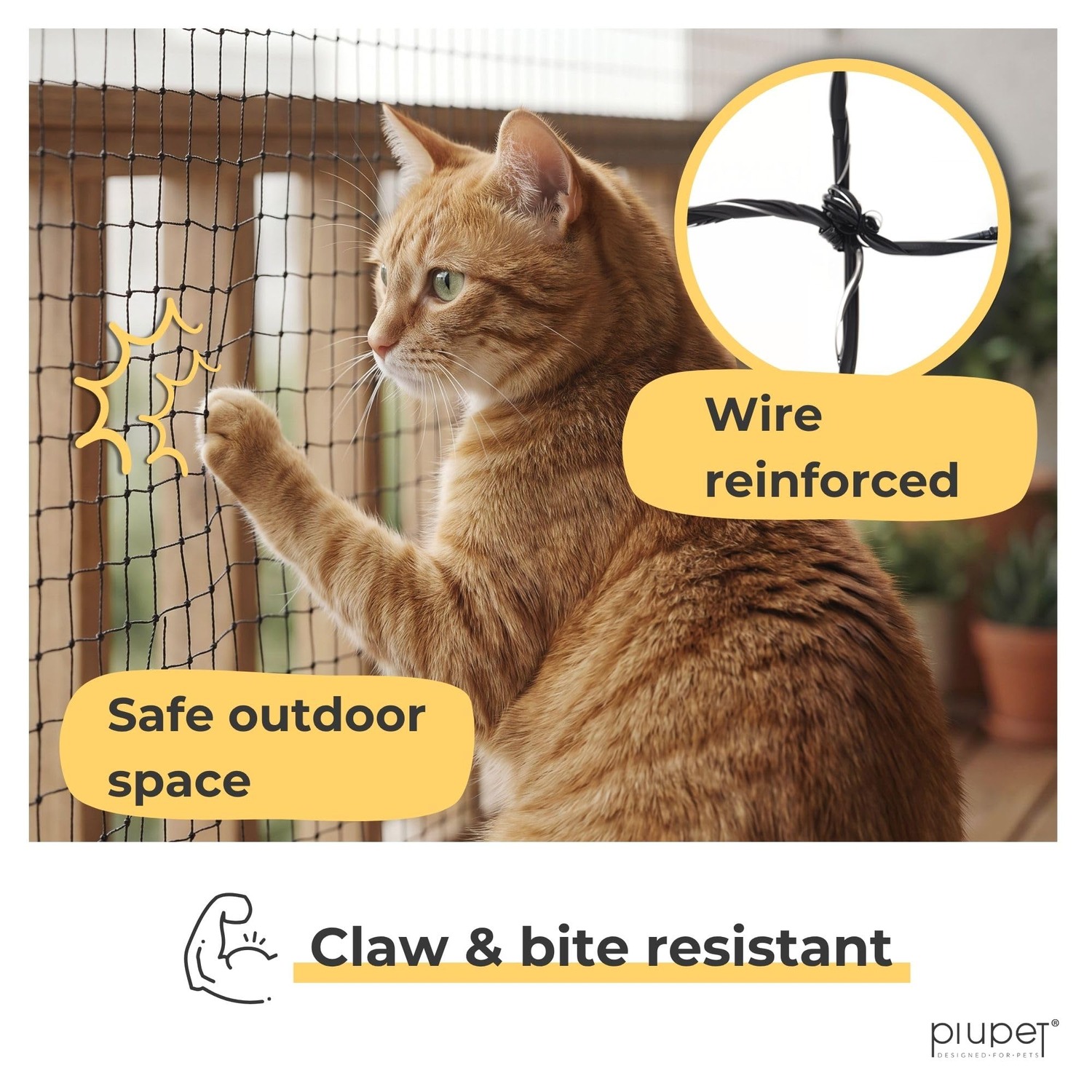
Where products differ is in the material and the mesh size. Plain plastic netting is cheap and fails fast. Cats chew. A bored cat will sit and work at one strand with their back teeth for twenty minutes, and plain polyethylene gives up eventually. This net is wire reinforced, meaning thin wire is woven through the PE strands. The mesh keeps the flexibility of netting while gaining the bite resistance of something much tougher.
Mesh spacing is the other factor. At 3x3cm, the openings are small enough that even a slim adult cat cannot force a shoulder through, which is the usual failure point. Wider meshes look better but give cats an obvious target. Tighter meshes block more of the view and catch more wind, which puts load on your fixings.
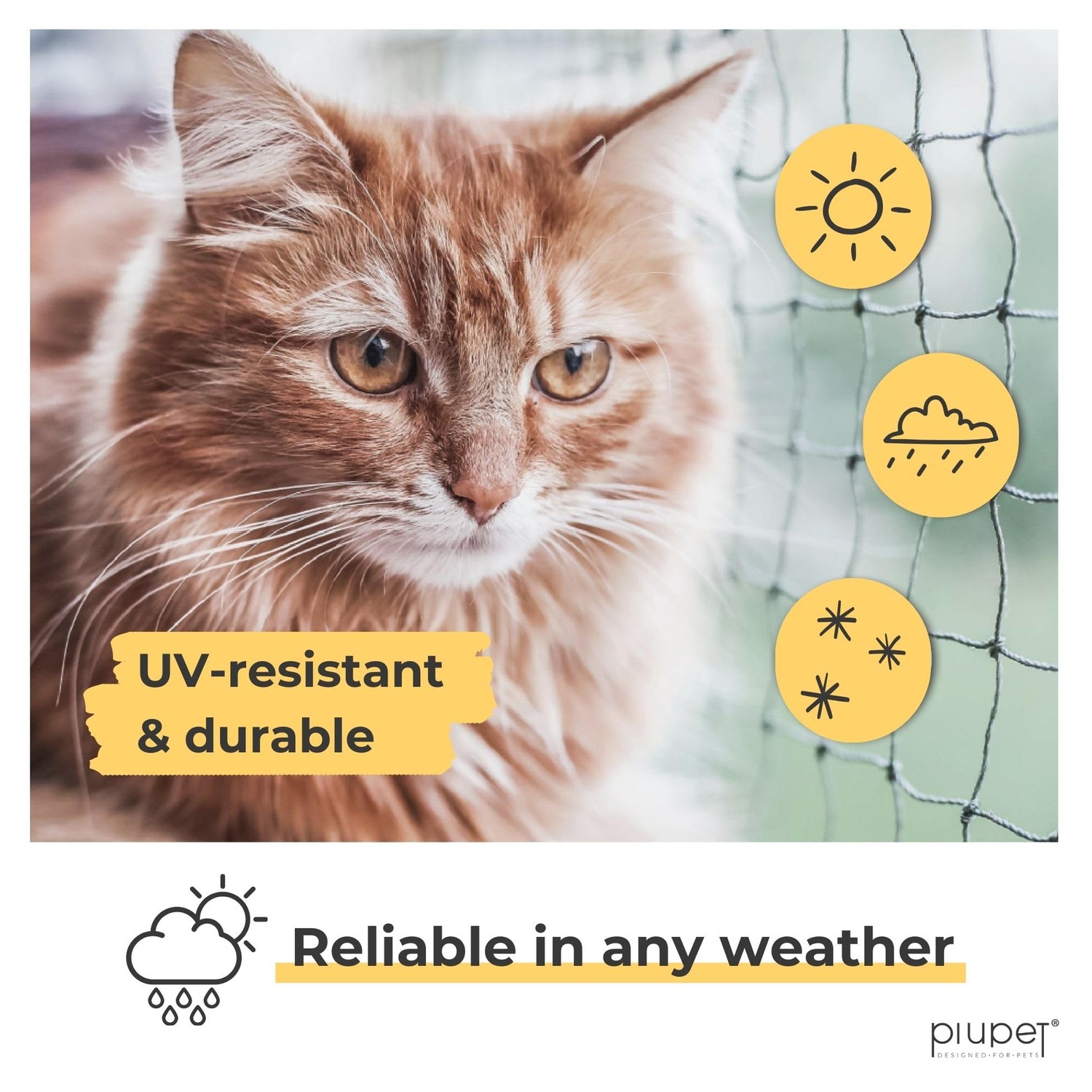
The material matters for longevity. Polyethylene handles UV and rain without going chalky and brittle the way some plastics do. That is the difference between a net that lasts a few seasons and one you are replacing after a single summer.
Who it suits
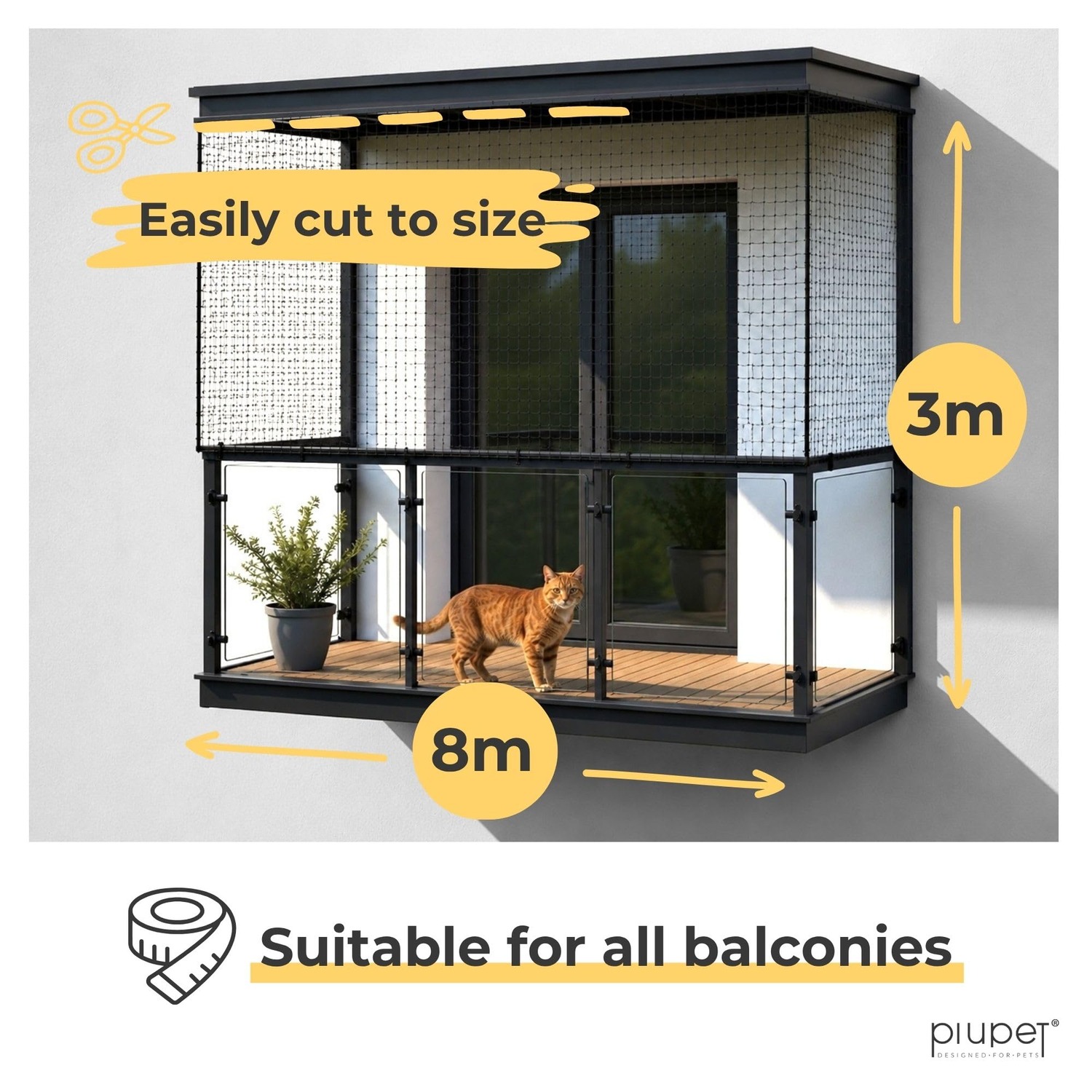
Apartment dwellers with a railing balcony are the obvious group. One 8 by 3 metre panel covers most standard balcony faces in a single piece, which avoids the weak point of joining two panels.
It also suits anyone with windows they want open in summer. Cut down to the reveal size, the same netting makes a window cat net that lets you leave the sash open overnight without the risk. Flyscreen is not enough for this. A cat leaning on flyscreen will pop it out of the frame, and most people only learn that once.
People building their own catio use this kind of netting as the skin over a frame. It is lighter and cheaper than welded wire panels, and easier to work with when you are cutting around awkward shapes. For a cat enclosure netting job, the main thing is keeping the frame rigid so the mesh stays taut.
It suits older cats and cats recovering from surgery too, where a bit of outdoor time helps but any jumping is a bad idea.
Who it does not suit: anyone looking for a human fall-safety product. This is a pet barrier. Treat it as one.
Choosing the right size and setup
Start with a tape measure, not a guess. Measure the full width of the opening you need to cover, then the height from the floor to whatever you will fix the top edge to. Add at least 20 centimetres on each dimension for overlap and tensioning. Netting pulled drum-tight with no margin is netting that tears at the fixing points.
Think about the top edge. Many balconies have an overhanging ceiling or a lintel to fix to, which is ideal. If yours is open above, you need to extend the net higher than a cat can jump from the railing, or accept that an athletic cat will go over.
Consider the sides. Side gaps where a balcony meets the neighbouring wall are the most commonly missed spot. Cats find them immediately. Walk the perimeter and look at it from cat height before you cut anything.
If you need more than one panel, overlap the join by at least 10 centimetres and lace the two edges together with the fixing rope. A butted join held with a handful of cable ties will open up.
For black netting against sky, visibility is genuinely low. If you want it even less noticeable, keep the net flat and even rather than letting it sag, because sag catches light and draws the eye.
Fitting it properly
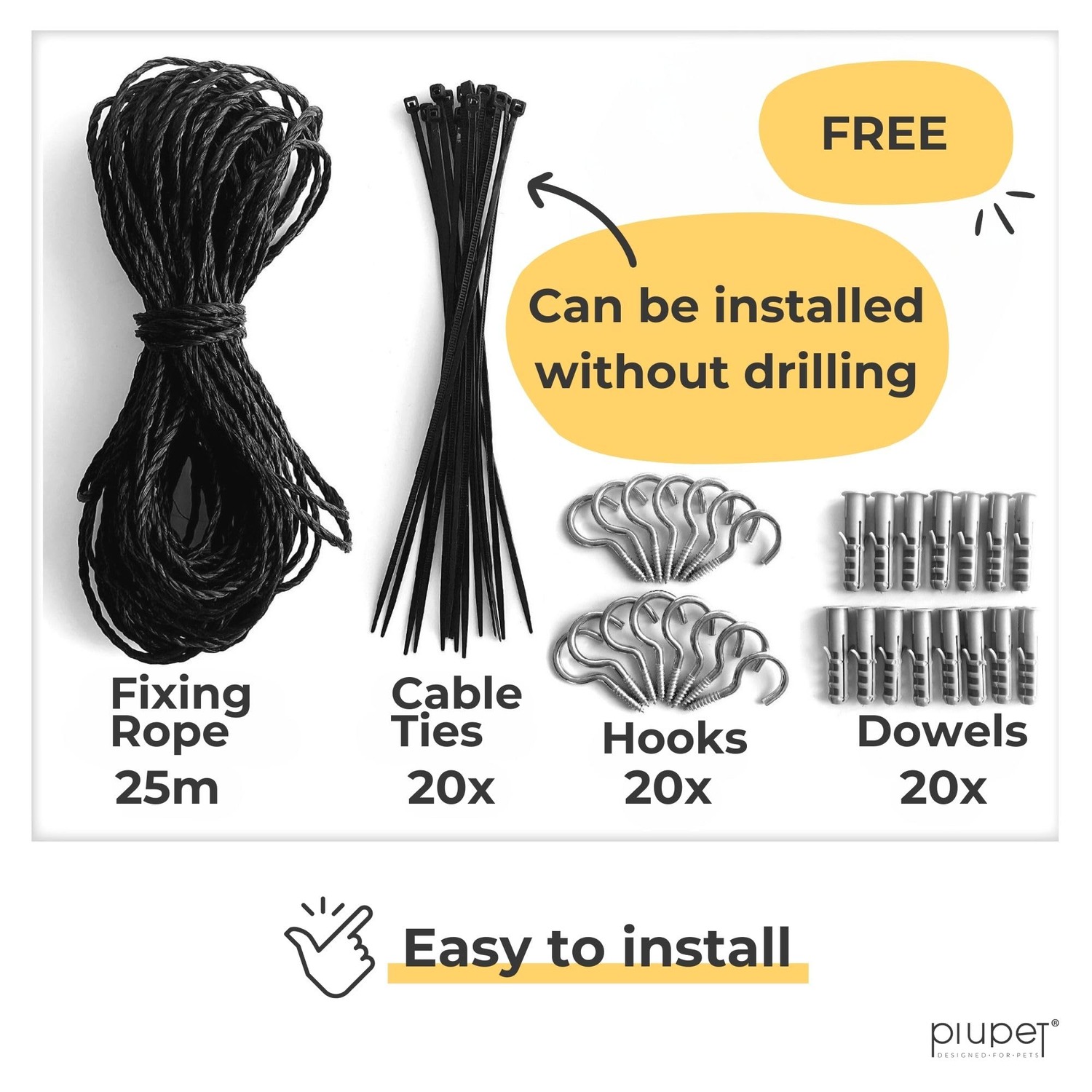
The included kit gives you two methods, and most installs use both.
For railings, thread the fixing rope through the edge of the mesh and lace it around the rail in a continuous spiral. Pull each loop snug as you go. Lacing beats tying individual knots because the load spreads across the whole edge rather than concentrating on a few points.
For walls, mark your hook positions first and space them 20 to 30 centimetres apart. Drill, insert the dowels, screw in the hooks, then hang the net across them. Twenty hooks and twenty dowels covers a typical balcony face. Work from one corner outwards and tension as you go, rather than hanging everything loosely and trying to tighten at the end.
Cable ties are for the detail work. Use them to close small gaps, secure overlaps, and tack the net down where it meets an awkward fitting like a drain or a hose tap.
Give the finished net a firm push with your palm at several points. If it moves more than a few centimetres, add fixings. Then let the cat out and watch what they do for the first half hour. Cats will find any weakness faster than you will.
Looking after it
Maintenance is light. Dust and cobwebs build up on outdoor mesh, so wipe it down with a damp cloth and a little mild soap a couple of times a year. Rinse and let it dry. Skip bleach and solvents.
Check the fixings each season. Rope stretches slightly, cable ties can go brittle in strong sun, and hooks can work loose in soft masonry. Five minutes with a screwdriver prevents the slow sag that eventually creates a gap.
Inspect the mesh itself around cat height, which is where chewing and claw damage shows first. Small damage can be laced closed with spare rope. Larger damage means replacing that section.
If you take it down over winter, dry it completely, fold it loosely rather than tightly, and store it in the dark. Sunlight through a shed window will do more damage to folded netting than a whole season outdoors will do to a tensioned one.
The short version
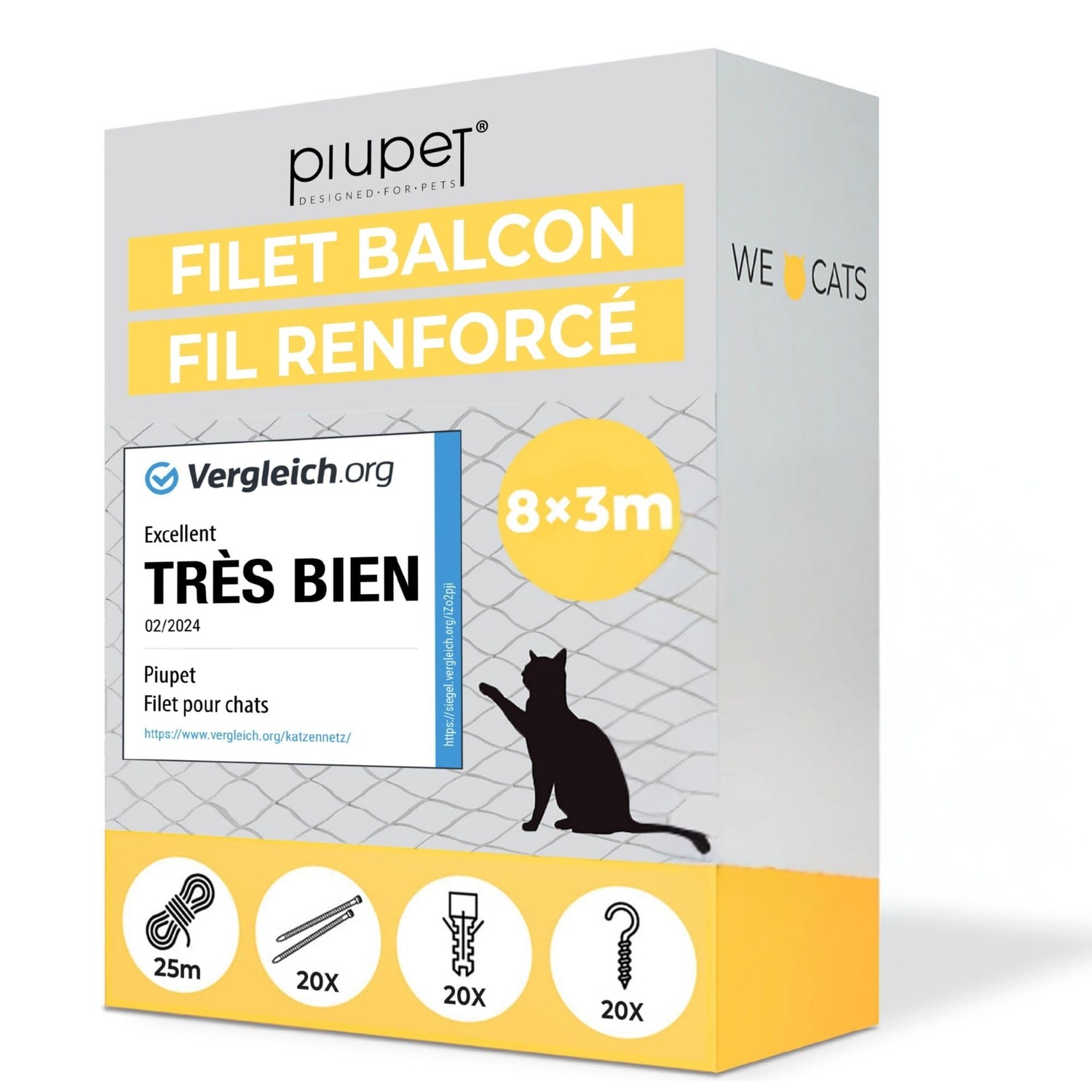
An 8 by 3 metre black polyethylene net with woven wire reinforcement, a 3x3cm mesh, and a fastening kit of rope, ties, hooks and dowels in the box. It weighs 2 kg and is made to live outside.
Measure carefully, cover the side gaps, fix every 20 to 30 centimetres, and keep it taut. Do that and your cat gets a balcony they can actually use, and you get to stop listening for the sound of claws on a railing.